
- About Us
- Events
- Membership
- Fellow Membership
- Reminiscences - Members
- Home
- SACNASP
- Awards
- News
- SA Journal of Chemistry
- Vacancies
- Notices & Announcements
- Chemistry Departments
- Interesting Websites
- Salary Survey

Advertise Here






Quick Links
 |
 |
 |
 |
 |
 |
 |
 |
 |
 |
 |
 |
 |
 |
 |
 |
 |
SACI Facebook : https://www.facebook.com/saci.official/
SACI Instagram: https://www.instagram.com/saci_chemistry/
SACI unveils new logo and slogan: a milestone in the Institute’s life
The South African Chemical Institute (SACI) recently hosted a special event to unveil its new logo and slogan, marking a significant moment in the institute’s journey. The event brought together more than 60 members to celebrate this transformation and reflect on the institute’s purpose and identity.
The event featured a thought-provoking talk by Dr. Greta Heydenrych, former Executive Director of IUPAC (2023–2024). Dr. Heydenrych engaged the audience with a compelling discussion on volunteerism in professional organisations, drawing parallels between IUPAC and SACI. She emphasised that people engage with societies like SACI for various reasons—be it passion for their field, opportunities for professional growth, or the sense of belonging to a vibrant scientific community. Highlighting examples from IUPAC, she illustrated how dedicated volunteers, many SACI members, drive the success of global chemistry initiatives. Dr. Heydenrych underscored that the essence of SACI’s rebrand is to reaffirm its role as a unifying force for chemists across South Africa, fostering innovation, collaboration, and growth.

The highlight of the event was the reveal of SACI’s new logo and slogan. The winning design features a stylised round-bottom flask forming the letter "C" with an outline of South Africa, incorporating SACI’s signature blue and gold colours. The new slogan, “Change through Chemistry,” captures the transformative impact of chemistry in society.

The event also celebrated the creative minds behind SACI’s new brand identity. Mercy Nduni, the winner of the best logo design, was recognised for her thoughtful and symbolic representation of SACI’s mission. Meanwhile, Lisa Gura and Marwaan Rylands were honoured as the co-winners of the best slogan competition. The slogan, “Change through Chemistry,” perfectly encapsulates the institute’s vision for the future, reinforcing the role of chemistry in driving innovation and societal progress.
The new SACI branding will take centre stage internationally at the upcoming Commonwealth Chemistry Congress from 11–14 May in Stellenbosch. This will be a prime opportunity to showcase SACI’s renewed identity on a global platform.
The unveiling event reaffirmed that SACI is more than just a professional society—it is a catalyst for advancing chemistry in South Africa and beyond. The new brand serves as a beacon of SACI’s commitment to growth, collaboration, and scientific excellence.
In closing, the SACI President, Prof Zenixole Tshentu, reflected on the lasting impact of this milestone, stating that “the logo and slogan will outlive us,” ensuring that SACI’s identity and mission continue to inspire future generations of chemists.
Niki Bathori, SACI Vice President
SACI/RSC
The President of SACI visits the Royal Society of Chemistry
The president of SACI, Prof Zeni Tshentu, was invited on behalf of the South African Chemical Institute (SACI) to attend the Summer Party and engage in a SACI-RSC MoU signing ceremony on the 25-25 July 2024. The events at the Burlington House in London included a President’s lunch with the SACI President, GDCh, IUPAC President, EuChemS, Honorary Fellows and members of the RSC Leadership Team and this was followed by the President’s Reception and a Summer Party on Thursday 25 July 2024. On Friday 26 July 2024, a ceremony was held for the renewal of the Memorandum of Understanding (MoU) between the Royal Society of Chemistry (RSC) and the (SACI). The MoU covers several areas of cooperation between the two societies around range of developmental agendas including co-hosting of scientific meetings and focus on the sustainability science trajectory. The president of SACI is very grateful for the opportunity to interact with the RSC Leadership Team and thanks them dearly for their hospitality. The president of SACI also thanks SACI for making the trip possible and for the support of EXCO.

The attendees at the President’s lunch outside the RSC offices at the Burlington House.

The President of the RSC (Dr Annette Doherty) and the SACI President (Prof Zeni Tshentu) at the MoU signing ceremony.
Statement on Diversity and Inclusion – South African Chemical Institute
The South African Chemical Institute is committed to diversity and inclusivity in chemical sciences. The Institute opposes discriminatory acts or threats based on race, ethnicity, citizenship, culture, language, disability, age, religious or spiritual beliefs, political opinion, gender, sexual identity, sexual orientation and economic class.
The Institute is dedicated (i) to endorsing excellence and scientific credibility across chemical sciences conducted in academic, industrial, and governmental institutions, and (ii) to nurturing the values of diversity, inclusivity, and equity in the chemical sciences in South Africa. Hence, SACI will continue to play a leading role in assuring the professional competence and integrity of chemists and fostering international collaboration whilst upholding inclusivity and diversity.
Statement on Sexual Harassment – South African Chemical Institute
The South African Chemical Institute will not permit any kind of sexual harassment (physical, verbal or non-verbal conduct) in the Institute or at events organised by or related to the Institute. The Institute is committed to and fully supports environments that are free of any form of unfair discrimination and harassment, including gender-based violence. Allegations of any form of sexual harassment will be dealt with seriously, expeditiously, sensitively and confidentially.
Statement from SACI Council on tertiary training in chemistry as a result of disruptions to the 2020 academic year due to the COVID-19 pandemic.
As the professional body representing the interests of all chemists in South Africa, we recognise the challenges that the current COVID-19 crisis presents to all our members in academia, research and industry. We also acknowledge the challenges the current situation presents to our tertiary institutions and specifically the challenges presented by moving to online teaching. We applaud the efforts of all our members who work at tertiary institutions who have adapted and innovated to ensure that we can continue as far as possible with our teaching and learning of chemistry even when on campus face-to-face contact is not possible. Our tertiary institutions play a critical role in not only training the next generation of chemists, but they are also tasked with the important responsibility of ensuring that many people from other professions and disciplines are trained in the fundamental principles of chemistry.
We reaffirm our belief that this training is essential, as chemistry is one of the central sciences. Key to this training is the practical component and laboratory based skills development. While we accept that this critical component of our training is not possible under the current situation, we strongly urge that plans be put in place to preserve this component of training as part of the curriculum as far as possible. In some cases, virtual laboratory tools can facilitate learning, but we believe that “in laboratory practical training” particularly for senior level courses should be preserved. SACI strongly recommends that at least a critical minimum practical experience should form part of the plans to complete the 2020 academic year at our tertiary institutions. We believe that this is essential to preserve the validity and integrity of the academic training programmes in chemistry.
Latest Updates:
Download Latest SACI Newsletter
Pay your SACI membership fees with SnapScan

SACI Ties, Scarfs and T-shirts

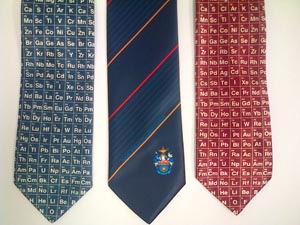
Periodic table ties and ladies scarfs R140 each.
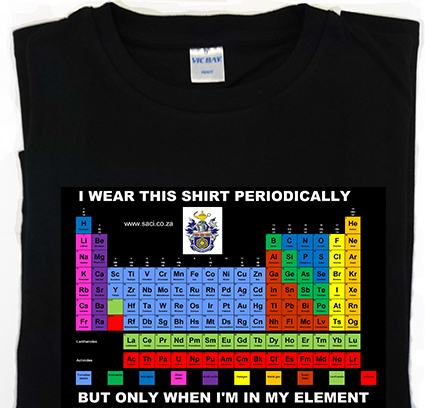
Periodic table T Shirt Short sleeve R200, Long sleeve R220
Please contact head office to place orders.
There is also a courier charge of R150 per order for delivery.


